
“I registered my business name with ASIC, so I own the brand.”
Unfortunately, that is wrong.
A registered business name and a registered trade mark do very different jobs. One helps identify who is trading under a name. The other can give you enforceable brand rights. Confusing the two can expose a business to rebranding costs, lost goodwill, trade mark disputes, urgent injunction threats and avoidable legal fees.
The short answer
Registering a business name with ASIC does not give you exclusive ownership of that name as a brand. ASIC itself says that registering a business name does not stop other people from using similar words or expressions in their business name and does not protect you from legal action if you use someone else’s trade mark:
ASIC guidance on registering a business name.
If you want brand protection, you usually need to consider trade mark registration through IP Australia. IP Australia explains that registering a trade mark gives exclusive rights to use a particular name, logo or slogan in connection with your products or services in Australia:
IP Australia guidance on trade marks, business names and domain names.
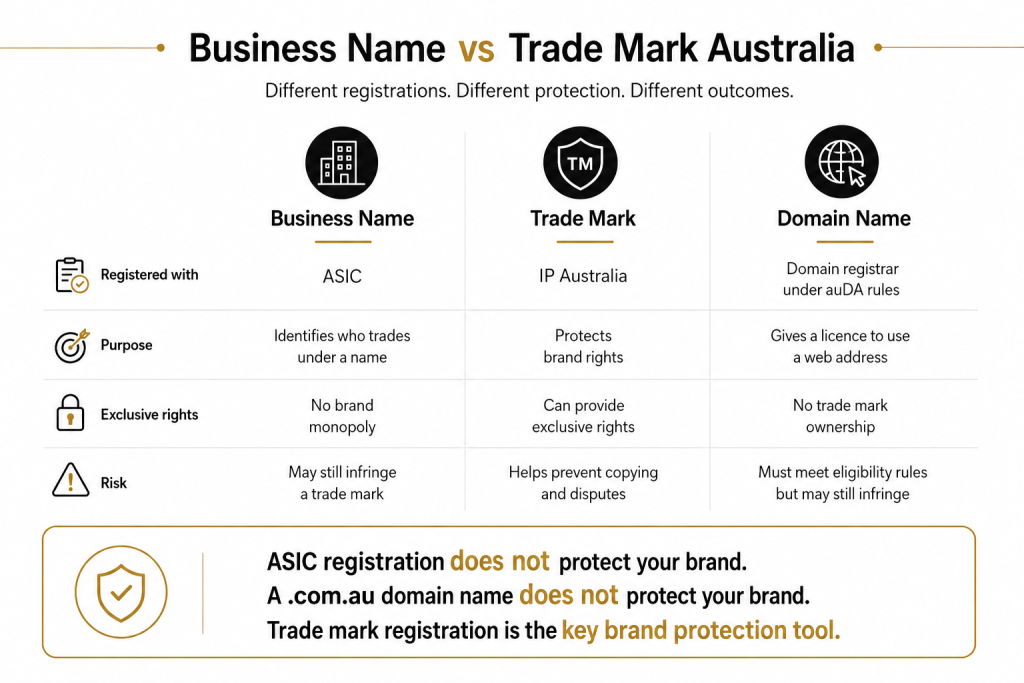
What is a business name?
A business name is the name under which a person, company, trust or partnership trades. In Australia, business names are registered with ASIC.
You may need to register a business name if you carry on business under a name other than your own personal name or your company name. For example, a company called Example Holdings Pty Ltd may need to register a business name if it trades as Example Plumbing.
A business name registration is mainly an administrative registration. It helps the public identify who is behind a business. It does not give the owner a monopoly over the words in the name.
SLK Lawyers has previously written about this issue in 3 things you need to know before choosing a business name.
What is a trade mark?
A trade mark is a sign used to distinguish one trader’s goods or services from another trader’s goods or services. It can include a word, phrase, logo, image, letter, number, colour, sound, movement, shape, scent or a combination of signs.
IP Australia describes a trade mark as legal protection for a company’s unique brand, product name or services What are trade marks?
A registered trade mark can give the owner exclusive rights to use, license and enforce the mark for the goods or services covered by the registration. This is why trade mark registration is often one of the most important legal steps when launching a new brand, product, software platform, franchise system, professional practice or ecommerce business.
For broader guidance on protecting commercial IP, see SLK Lawyers’ article How to protect your intellectual property.
Business name vs trade mark: the key differences
| Issue | Business name | Trade mark |
|---|---|---|
| Registered with | ASIC | IP Australia |
| Main purpose | Identifies who is trading under a name | Protects a brand as intellectual property |
| Exclusive rights | No general exclusive brand rights | Can provide exclusive rights for specified goods or services |
| Stops similar names | Generally no | Potentially yes, depending on similarity, goods, services and other legal issues |
| Protects against infringement claims | No | Can reduce risk if properly searched, filed and used |
| Best used for | Trading name compliance | Brand protection and enforcement |
Why ASIC approval can give false comfort
ASIC may allow you to register a business name even though that name creates trade mark risk. That is because the business names register and the trade marks register serve different legal purposes.
A business name may be available because no one has registered that exact or near exact business name with ASIC. That does not mean the name is safe to use as a brand.
For example, a proposed business name could still be risky if:
- it is similar to an existing registered trade mark;
- it is used for similar goods or services;
- the other trader has a reputation in the name;
- customers may think the businesses are connected;
- the other trader has prior common law rights; or
- the name contains a distinctive word already used by another brand in the same industry.
ASIC’s guidance is blunt: only a trade mark can give you exclusive rights to use your trade mark:
ASIC business names vs trade marks.
Can you infringe a trade mark if your business name is registered?
Yes.
Business name registration is not a defence to trade mark infringement. If your business name is being used as a brand and it is substantially identical with, or deceptively similar to, someone else’s registered trade mark for the same or related goods or services, you may face a legal claim.
In practical terms, this means a business can pay ASIC, register a name, build a website, order signage, print packaging, open social media accounts and still be forced into a dispute because the name infringes another trader’s rights.
That is why a proper brand clearance process should happen before launch, not after the business has built goodwill under the name.
What should you search before choosing a business name?
Before adopting a new business name or brand, a prudent business owner should search more than the ASIC business names register.
At a minimum, you should consider:
- the ASIC business names register;
- the Australian Trade Mark Search database;
- company names;
- domain names;
- social media handles;
- Google search results;
- industry directories;
- marketplace listings;
- overseas trade marks if international expansion is likely; and
- unregistered competitors with established reputation.
IP Australia provides an Australian Trade Mark Search tool:
How to search existing trade marks.
Business.gov.au also recommends checking whether a proposed trade mark is available before applying:
Business.gov.au guidance on trade marks.
Do you need both a business name and a trade mark?
Often, yes.
A business name deals with trading name registration. A trade mark deals with brand protection. They are not substitutes.
A company might need:
- a company name, such as Example Group Pty Ltd;
- a registered business name, such as Example Plumbing;
- a domain name, such as exampleplumbing.com.au;
- a registered trade mark for EXAMPLE PLUMBING;
- a registered logo trade mark; and
- trade mark registrations for product names, software names or slogans.
The exact structure depends on the business model, the brand, the goods or services, the expansion plan and the level of risk the business is prepared to accept.
What about .com.au domain names and auDA rules?
A domain name is also different from a business name and a trade mark. Registering a .com.au domain name does not give you ownership of the brand. It gives you a licence to use that domain name, subject to the .au Domain Administration rules.
For .com.au and .net.au domain names, the registrant must have an Australian presence and the domain name must be an exact match, abbreviation or acronym of the registrant’s name or trade mark, or otherwise closely and substantially connected to the registrant. This can include a connection to the registrant’s products, services, premises, events or activities.
This means a business name, company name or trade mark may help support eligibility for a .com.au domain name. However, domain eligibility is not the same as trade mark protection. A domain name may comply with auDA rules but still infringe someone else’s trade mark.
The key point is that a .com.au domain name sits in a third category. It is not a business name and it is not a trade mark. It is a licensed domain name that must satisfy auDA’s eligibility and allocation requirements.
You can read more in the auDA rules:
.au Domain Administration Rules: Licensing.
The real commercial risk: rebranding after launch
The legal issue is only part of the problem. The commercial risk can be worse.
If you adopt a name without checking trade mark risk, you may later need to:
- change your trading name;
- change your company branding;
- replace signage, uniforms, packaging and stationery;
- move to a new domain name;
- change social media handles;
- rebuild Google rankings;
- explain the change to customers;
- deal with marketplace takedowns;
- respond to a cease and desist letter; and
- pay damages, legal costs or settlement money.
These risks are magnified where the business has already invested in marketing, franchising, ecommerce, product packaging, premises fitouts or app development.
Common myths about business names and trade marks
Myth 1: “ASIC accepted the name, so it must be legally safe.”
Wrong. ASIC registration does not mean IP Australia would accept the name as a trade mark. It also does not mean the name avoids infringement risk.
Myth 2: “I own the .com.au domain, so I own the brand.”
Wrong. A domain name is an address. It is not the same thing as a trade mark.
Myth 3: “My logo is different, so the name is safe.”
Not necessarily. A different logo may help in some cases, but word similarity can still create risk, especially where the businesses operate in the same field.
Myth 4: “The other business is in another state, so it does not matter.”
Usually wrong. Registered Australian trade marks are national. Online businesses, ecommerce and social media also make geographic arguments less reliable than many business owners assume.
Myth 5: “The word is descriptive, so nobody can own it.”
Sometimes true, often too simplistic. Descriptive words can be harder to protect, but trade mark disputes often turn on the whole mark, the goods or services, reputation, prior use, consumer perception and the actual way the sign is used.
When should you speak to a lawyer?
You should get trade mark advice before adopting a new brand if:
- the brand will be central to your business value;
- you plan to franchise, license or sell the business;
- you will spend money on signage, packaging, marketing or software development;
- you operate in a crowded market;
- a competitor uses a similar name;
- you have received a cease and desist letter;
- you want to oppose another trade mark application;
- you want to enforce your brand rights; or
- you are buying a business and need to check whether the brand is properly protected.
SLK Lawyers advises business owners on intellectual property, trade marks, business purchases, brand protection and commercial disputes. You can read more about our intellectual property services.
Practical checklist before choosing a business name
- Search ASIC for identical or near identical business names.
- Search the Australian Trade Mark Search database.
- Check similar spellings, plurals, abbreviations and phonetic equivalents.
- Search competitors in the same industry.
- Check domain names and social media handles.
- Consider whether the name is distinctive enough to register as a trade mark.
- Check whether the name describes the goods or services too directly.
- Assess whether overseas protection is needed.
- File the trade mark before investing heavily in the brand.
- Keep evidence of first use, including launch dates, invoices, screenshots and marketing materials.
Frequently asked questions
Does registering a business name protect my brand in Australia?
No. Registering a business name with ASIC lets you trade under that name, but it does not give you exclusive ownership of the name as a brand. Trade mark registration is the main way to obtain exclusive rights to use a brand name for specified goods or services in Australia.
What is the difference between a business name and a trade mark?
A business name is the name under which a business trades and is registered with ASIC. A trade mark is intellectual property registered with IP Australia and can protect a brand name, logo, phrase, image, sound, shape, colour, movement, scent or other sign that distinguishes goods or services.
Can I infringe a trade mark even if ASIC accepted my business name?
Yes. ASIC registration does not clear trade mark risk. If your business name is identical or deceptively similar to someone else’s registered trade mark for the same or similar goods or services, you may face a trade mark infringement claim.
Do I still need a business name if I register a trade mark?
Usually yes. A trade mark protects brand rights. A business name registration deals with the legal requirement to trade under a name that is not your own personal name or your company name. Many businesses need both.
Should I search trade marks before registering a business name?
Yes. You should search the Australian Trade Mark Search database before registering or using a business name. A business name may be available through ASIC but still create trade mark infringement risk.
What should I do if someone else is using a name similar to mine?
You should first check whether you own a registered trade mark, whether the other business uses the name for similar goods or services, who used the name first, and whether there is evidence of confusion. You should obtain legal advice before sending a demand letter or responding to one.
Key takeaway
A business name is not brand protection. A domain name is not brand protection. A company name is not brand protection.
If the name matters to the value of the business, treat it as intellectual property from the start. Search it properly, assess the risks, and consider trade mark registration before competitors, copycats or prior rights holders become a problem.
Book an appointment with one of our Lawyers to discuss your specific needs.
Book a ConsultationA Note on the Information We Share
Reading this information does not create a lawyer-client relationship between you and SLK Lawyers. This only occurs with a formal written agreement. Content is current at publication and applies to Victorian law unless stated otherwise. It is general information only and not a substitute for specific legal advice. Strict time limits apply to legal claims. You should seek immediate legal advice on your specific situation to ensure your rights are protected.